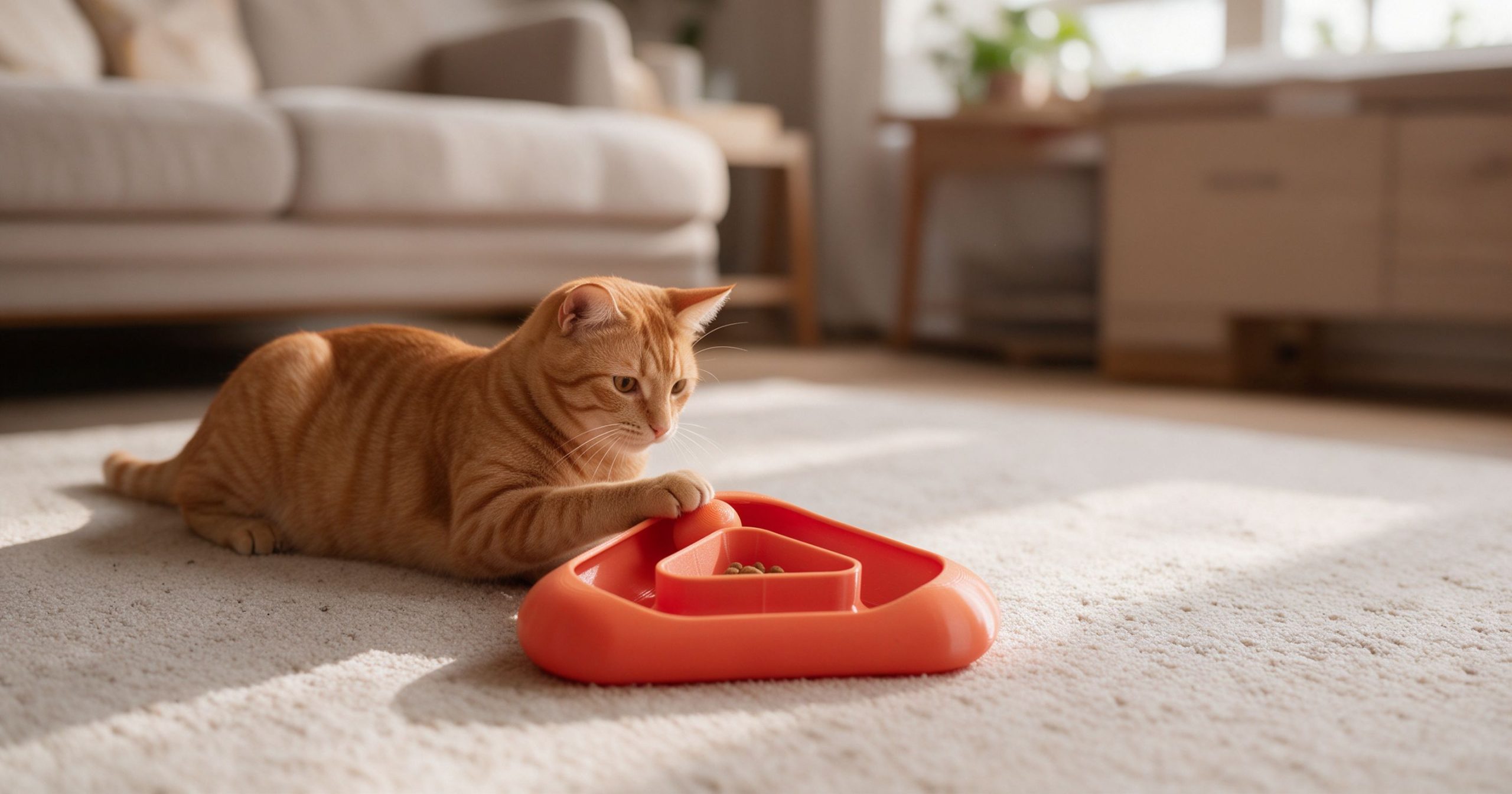
You leave for work, and by the time you get home the couch has a new fringe, a plant has been excavated, or your cat is staring at you like you’ve been gone for a decade. Indoor cats don’t act out of spite. They’re under-stimulated. A cat’s body and brain are built for a long series of short stalk-and-pounce cycles every day, and when the kibble simply appears in a bowl for free, all that hunting energy has nowhere to go.
The good news: you don’t need to work from home or buy a roomful of gadgets to fix this. A well-designed environment lets your cat hunt, play, eat and rest on their own schedule, so they’re calm and content instead of bored or anxious. Here’s a practical 7-step plan you can set up this weekend, plus a five-minute morning routine to run before you walk out the door.
Why indoor cats need a “job”
Outdoor cats spend a large part of their waking hours searching, stalking, chasing and finally eating their food. Indoor cats get all of their meals in seconds, with zero effort. That leaves a big gap between the mental and physical activity their instincts expect and what a quiet living room actually provides.
That gap usually shows up in one of three ways: destructive behavior around the home, attention-seeking meowing or nipping, or the opposite extreme — long stretches of listless sleeping and over-eating. Food puzzles and self-play toys work because they replace the missing hunt. Your cat gets to problem-solve, bat, nudge and earn a meal, which is far more tiring than crunching from a bowl.
1. Give them a high window with a view
Before you buy a single toy, set up one comfortable perch where your cat can look outside. A window seat, a shelf beside a bird feeder, or the top level of a cat tree turns passing birds, squirrels and traffic into free, ever-changing television. A cat who can survey their territory from up high also feels safer, which matters when the house is empty and quiet.
2. Move part of every meal into a food puzzle
This is the single highest-impact change you can make. Instead of dumping breakfast in a bowl, put a portion of your cat’s dry food into a puzzle feeder or slow-feeder bowl. They now have to sniff, nudge and bat to release each mouthful, which stretches a thirty-second meal into a satisfying, mentally tiring foraging session.
Slow feeding helps fast eaters eat at a calmer pace, and working for their food gives indoor cats the mental stimulation an ordinary bowl simply can’t. Start easy — loosely scattered kibble or a wide, open puzzle — and make it harder only once your cat is confident, so the game feels rewarding rather than frustrating.
3. Leave at least one safe toy they can work themselves
Wand toys and lasers are wonderful, but they need you. For the hours you’re away, your cat needs a toy that delivers play without supervision. A ball track is ideal: a ball loops around a continuous rail, so every swipe sends it rolling back for another round. The repetition is genuinely engaging for cats, and it doesn’t require any clever mechanisms or batteries.
When you’re comparing self-play toys, favor ones that are a single solid piece with no loose parts. Collar charms, dangling strings, detachable feathers and tiny accessories are exactly what you don’t want around an unattended cat. Our 2-in-1 cat ball track and slow feeder bowl combines the rolling track with a central treat bowl in one 3D-printed piece, so the self-play and the foraging happen in the same tidy, nothing-to-swallow design.
4. Rotate toys instead of leaving them all out
A toy on the floor every single day stops being a toy and becomes furniture. Keep a small box of four or five independent toys, and leave out only two or three at a time, swapping them every few days. When a ball track or crinkle mouse reappears after a week away, it feels brand new again. A cheap, simple rotation does more for sustained interest than a huge pile that never changes.
5. Give a sturdy, approved place to scratch
Scratching isn’t a behavior problem — it’s stretching, nail maintenance and scent-marking, and your cat will do it whether you provide somewhere or not. Protect the sofa by giving a scratching post that’s tall enough for a full stretch, stable enough not to wobble, and placed near where they already nap or walk in. A post that’s hidden in a back room won’t get used; one beside the sofa or bed will.
6. Remove anything unsafe for solo time
Walk through your home the way a bored, determined cat would and put away anything that could be chewed, knocked over or swallowed while you’re gone:
- Loose string, rubber bands, hair ties, dental floss and tinsel
- Toys with small parts, glued-on eyes or easily detached feathers
- Reed diffusers, candles, essential oils and toxic houseplants
- Plastic bags, blind cords and anything small enough to swallow
Prefer one-piece toys without clip-on pieces, and keep battery-operated or motorized toys for supervised play only. This is exactly why we print our enrichment toys as a single solid PETG part — no panels that pop apart and nothing small that can end up in a curious mouth.
7. Bookend the day with two short play sessions
Solo enrichment does the heavy lifting during the day, but you are still your cat’s favorite toy. Spend about ten minutes in an interactive hunt before you leave and again after you get home: wand or teaser, a few high-energy chases, then a calm wind-down and a small meal. That sequence — chase, catch, eat — is the hunting loop your cat is wired to complete, and ending it with food signals that the hunt is over and it’s time to groom and sleep.
Your five-minute morning setup
Once the space is arranged, each weekday morning is quick:
- Portion breakfast into the puzzle feeder or slow-feeder bowl.
- Set out two or three rotated solo toys, including the ball track.
- Open the blinds at the perch so there’s a view.
- Top up fresh water and confirm the litter box is clean.
- Do a quick scan for string, small parts and toppling hazards.
That short routine covers food, play, safety and comfort for the entire day, with no screens or timers required.
Frequently asked questions
How long is too long to leave an indoor cat alone?
Most healthy adult cats do fine for a typical workday as long as their food, water, litter and enrichment are set up beforehand. Kittens, seniors and cats with medical or separation-anxiety needs may require a midday check-in, and long workdays that stretch into the evening are a good reason to invest in stronger solo enrichment or a pet sitter.
Why does my cat just sleep all day when I’m gone?
Cats naturally rest a lot, and a sleeping cat isn’t necessarily a problem — but if they sleep out of boredom and then explode into chaos at night, the day is too empty. Add a food puzzle and a self-play toy, then shift a little of the evening play to the morning so they have a reason to be active.
What if my cat doesn’t understand the puzzle feeder?
Make it easier, not harder. Start with kibble loosely placed so it falls out with a single nudge, let them watch you put the food in, and gently roll the ball or move the pieces yourself the first few times. Once they make the connection, you can gradually increase the difficulty.
Does this work for small dogs and puppies too?
Yes. The same logic — foraging, safe solo play and slower meals — applies to small dogs and puppies, which is why a combined enrichment toy and slow-feeder is sized for both cats and small dogs. Always choose a size appropriate for your pet and supervise the first few sessions.
Start with the enrichment that does two jobs at once
If you’re setting up a single starter kit, the most useful piece is the one that covers both self-play and food enrichment. A ball track gives your cat the chase, and a central treat bowl gives them the hunt that ends in a meal. Our 2-in-1 cat ball track and slow feeder bowl is made to order as one quiet, durable PETG piece — no rattle, no batteries, no small parts — and is ready to use straight out of the box. Set it up with a portion of kibble before work, and your cat gets a fuller, calmer day even while you’re away.