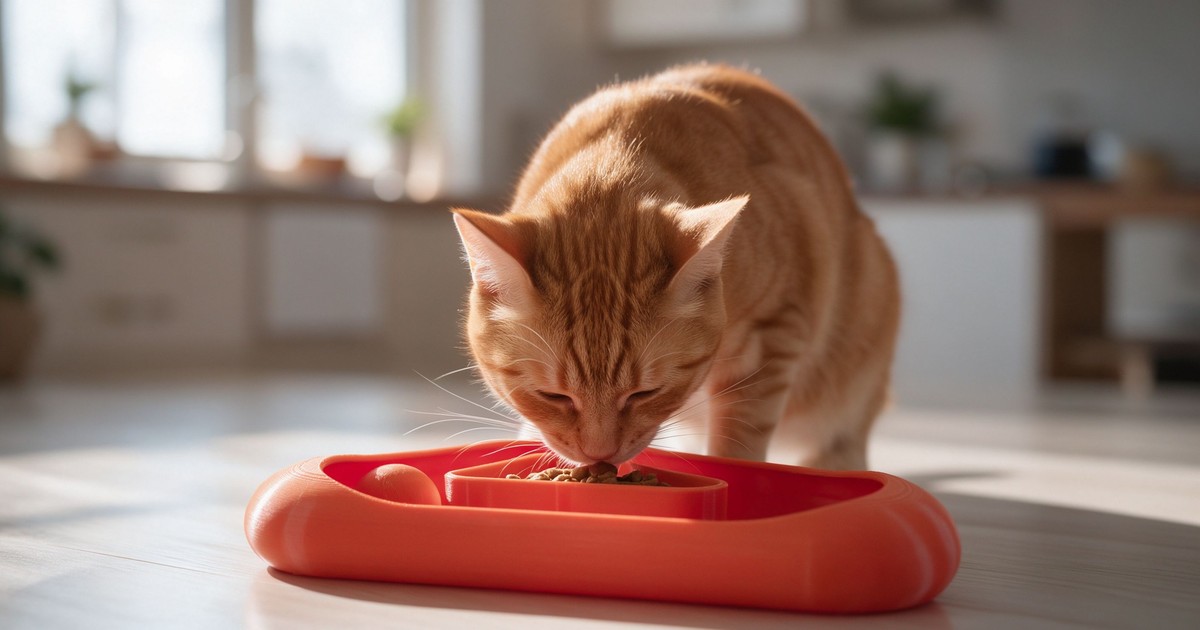
Your cat hears the kibble hit the bowl and sprints in like it’s the last meal on Earth. Thirty seconds later the bowl is empty — and a few minutes after that, you find a neat, tube-shaped pile of barely chewed food on the floor. If this sounds familiar, you’re dealing with one of the most common (and most misunderstood) feeding problems in cats: the “scarf and barf” reflex.
The good news is that it’s rarely a sign that something is seriously wrong, and it’s one of the easiest feeding problems to fix. Most of the time, the answer isn’t a different food or a scolding — it’s a simple tool called a slow feeder bowl. Here’s what’s happening, why it matters, and exactly how to slow a speed-eating cat down.
First: Is it regurgitation or vomiting?
These two words get used interchangeably, but they’re not the same thing — and telling them apart is the first step toward knowing whether you can fix this at home.
Regurgitation (the classic “scarf and barf”)
- Happens fast, usually within minutes of eating, sometimes right next to the bowl.
- No effort or warning — the food seems to simply come up; your cat may look surprised and then walk away.
- The food is slippery, tube-shaped, and barely digested, often coated in clear saliva.
- It’s a passive motion from the esophagus, not a stomach heave.
Vomiting (which needs more attention)
- Has a build-up: drooling, lip-licking, retching, and visible abdominal heaving.
- The food is partially digested, or you see yellow bile, white foam, or (rarely) blood.
- It can happen hours after a meal and isn’t always tied to eating.
Fast-eating almost always causes regurgitation. If your cat is genuinely vomiting — especially repeatedly — that’s a different conversation and a reason to call your vet.
Why do cats eat so fast in the first place?
It helps to remember that your house cat is still, biologically, a small solitary hunter. A wild cat doesn’t get two big meals served in a bowl — it catches many small prey animals throughout the day and eats them slowly. Our feeding routine is the exact opposite: a large, unrestricted pile of food delivered once or twice a day to an animal wired to graze.
A few specific things make the problem worse:
- They can’t really “chew.” A cat’s jaw can’t move side-to-side to grind the way ours does. Their teeth are built for slicing and tearing, so small kibble often gets swallowed whole.
- Kibble expands. When dry food hits the stomach it absorbs fluid and swells, while gulping traps a lot of air. Together they send an urgent “overfull” signal, and the stomach sends the meal straight back.
- Competition and worry. In a multi-cat home, pets learn to bolt food before a housemate can steal it. Cats that previously went hungry — many rescues — keep that survival habit even when food is now reliable.
- Long gaps and boredom. A cat left alone all day with nothing to do may attack every meal out of sheer excitement and routine.
The real cost of speed-eating
An occasional regurgitated meal isn’t an emergency, but letting it continue can cause more than carpet cleanup:
- Frequent regurgitation, gagging, and digestive discomfort
- A small but real risk of choking on a large mouthful
- Irritation of the esophagus over time
- Poor nutrient absorption when food never gets properly chewed
- Weight gain: when a meal vanishes in under a minute, the brain doesn’t get the signal that the cat is full, so it keeps asking for more — and well-meaning owners overfeed.
How a slow feeder bowl fixes it
A slow feeder cat bowl has raised ridges, pillars, or a gentle maze built into the eating surface. Instead of one open pile, the kibble is split into small pockets, and the cat has to use its tongue, teeth, and sometimes a paw to work each bite out. The cat can’t grab a huge mouthful, because there isn’t one.
The effect is dramatic: a meal that used to take 30–60 seconds can stretch to 5–10 minutes — roughly 5 to 10 times slower. That slower pace does three important things:
- It removes the trigger for regurgitation — far less air is swallowed, and the stomach isn’t suddenly filled with expanding kibble.
- It lets fullness catch up, so the cat feels satisfied on the correct portion instead of begging for seconds.
- It turns the meal into a small hunt, which is genuinely enriching for an indoor cat.
Look for a bowl that’s wide and shallow rather than deep and narrow. Cats have extremely sensitive whiskers, and forcing them to press into a deep bowl causes “whisker fatigue” that can make some cats refuse to eat at all.
Slowing down is the same as “working” for food
Here’s the part most owners miss: a slow feeder isn’t just a digestive aid, it’s a form of food puzzle — and food puzzles are one of the best-supported enrichment tools in feline veterinary medicine.
A widely cited review in the Journal of Feline Medicine and Surgery (Dantas, Delgado, Johnson & Buffington, 2016) found that food puzzles support cats’ physical and emotional wellbeing. Reported benefits included weight loss in obese cats, reduced stress and anxiety, less reactivity toward people and other pets, and fewer attention-seeking and inappropriate-elimination behaviors. The case studies are striking: one obese cat lost about 20% of its body weight over a year once meals came through puzzles rather than a free bowl.
The researchers noted that essentially every cat can use food puzzles — kittens, seniors, even cats with disabilities — as long as the challenge is matched to the cat and introduced gently.
How to introduce a slow feeder without frustrating your cat
Buying the hardest “maze” on day one is the most common mistake. A frustrated cat doesn’t become enriched; it walks away hungry or begs harder. Take it in steps:
- Start easy. Use a shallow, low-ridge design and place the new bowl right next to the old one for a few meals.
- Load it generously at first. When kibble is easy to reach, the cat learns the new bowl delivers food. You can make it harder over time.
- Swap one meal at a time once your cat is confidently eating from it.
- Stay nearby for the first week, praise the effort, and check that your cat is actually finishing the portion.
- In a multi-pet home, feed separately. Each cat should have its own puzzle, and a dog should be kept away from the cats’ food at mealtime.
If your cat “solves” the bowl after a couple of weeks and starts gulping again, just change the format — rotate in a different obstacle or a ball-style feeder. The friction is what matters, not the specific gadget.
When to call the vet instead
A slow feeder is a fix for pace, not a cure for illness. Contact your veterinarian if you notice:
- True vomiting — heaving, bile, or foam — rather than passive regurgitation
- More than an occasional episode, or vomiting that lasts more than a day
- Blood, a foreign object, or signs of pain
- Sudden weight loss, ravenous appetite, or a change in drinking and litter habits (which can point to thyroid problems, diabetes, or parasites)
- A cat that stops eating altogether
One bowl that does both jobs
Most slow feeders on the market only slow a meal down, and most self-play toys don’t hold food — so owners end up buying two separate products. Our 2-in-1 ball track and slow feeder bowl combines them in a single 3D-printed piece. The raised center works as a gentle, whisker-friendly slow feeder and foraging puzzle, while the quiet outer ring track lets the same cat bat a ball and self-play between meals. It’s one lightweight, seamless piece with no small snap-together parts to come loose or trap a paw.
If you’d like to browse the rest of the range, the Shop lists every made-to-order piece. And for the bigger picture of daytime routines, perches, and toy rotation, our guide on keeping an indoor cat entertained while you’re at work builds a complete plan around this bowl.
Frequently asked questions
My cat brings up whole food right after eating — is that an emergency?
Usually not. Passive, tube-shaped regurgitation of barely chewed food shortly after a meal is the classic fast-eating pattern, and a slow feeder commonly resolves it within a few days. Active heaving, bile, blood, or repeated episodes are a reason to call the vet.
How quickly will a slow feeder work?
Many owners see a clear drop in regurgitation within the first week, simply because the cat is swallowing less air and eating at a natural pace. Introduce it gradually and give your cat a few days to adjust.
My small dog or puppy also bolts food — can they use it?
Yes. The same principles apply to small dogs and puppies that eat too fast, and the compact size suits cats and small dogs alike. Larger breeds need a bigger bowl, and long-eared dogs may prefer a different shape.
What if my cat just paws the food out or gives up?
Pawing kibble out is normal foraging — let them. If the cat walks away frustrated, simplify the design, spread the food more loosely, and make the very first sessions easy enough to succeed at. The goal is a calm, winnable meal, not a hard puzzle.
The takeaway
A cat that eats too fast and throws up isn’t being greedy or difficult — it’s an animal wired to hunt and graze, being asked to eat a large, free pile in seconds. Add a little friction with a slow feeder bowl, introduce it kindly, and you turn a stressful 30-second binge into a calm, natural, five-minute meal that’s easier on digestion and more interesting for your cat.